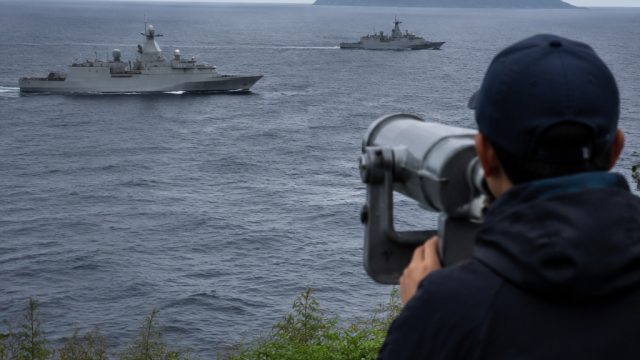
In a significant escalation of geopolitical tensions, leaders from the United States, United Kingdom, France, and Germany have jointly expressed concerns about China's military activities in the waters surrounding Taiwan. This alarm comes in the wake of increased Chinese patrols and the recent maneuvering of advanced naval assets in the region, raising eyebrows among global observers and analysts alike.
China's assertive military posture has been a focal point of international scrutiny in recent weeks. Observers note that the People's Liberation Army (PLA) has intensified its presence near Taiwan, signaling a potential shift in strategy regarding its claim over the island. The four nations’ joint statement highlights not only their unease but also a concerted effort to address the implications of China's actions on global security.
China's military maneuvers include the deployment of its newest aircraft carrier, the Fujian, which recently traversed the Taiwan Strait amid military drills. This display of naval power has raised alarms and prompted discussions about the balance of power in the region. The Western nations believe that such actions could destabilize an already delicate situation and potentially lead to miscalculation or conflict.
The situation surrounding Taiwan is not merely a regional concern; it plays a vital role in the larger context of international relations and global security. Taiwan, a self-governing democracy, has longstanding tensions with Beijing, which considers it a breakaway province. The ongoing militarization of the Taiwan Strait could lead to increased friction not just in Asia, but also affect global trade routes and economic stability.
As nations navigate these troubled waters, the need for strategic alliances becomes ever clearer. Countries are not only weighing their military capacities but also assessing their diplomatic ties and economic partnerships. The current geopolitical climate emphasizes collaboration among Western powers to counterbalance China's growing influence.
The urgency of this situation cannot be overstated. As the world wrestles with various crises, including economic recovery from the pandemic and ongoing global conflicts, the potential for a new flashpoint in Asia adds another layer of complexity. International investors and corporations are watching the situation closely, as instability in Taiwan could affect markets and supply chains worldwide.
Looking ahead, the responses from the international community will play a critical role in shaping the future of the Taiwan Strait and, by extension, global stability. While diplomatic channels remain open, the stakes continue to rise as China asserts its position. Leaders around the world must navigate these challenges with a blend of caution and resolve to prevent escalation.
As tensions rise in the Taiwan Strait, the collective alarm sounded by major Western powers signals a pivotal moment in international relations. The implications of China's military activities extend beyond the immediate geographic area, potentially affecting global security and economic stability. Keeping a close watch on these developments is essential for understanding future dynamics in the region.

The Evolution of Global Trade:
Explore the evolution of globa...(20 ) viewsTime:2026-07-09
Top Strategies for Effective B
Learn key strategies for estab...(28 ) viewsTime:2026-07-09
The Rising Importance of Suppl
Learn about the significance o...(85 ) viewsTime:2026-07-09
Global Trade Policies: Their I
Examine how global trade polic...(164 ) viewsTime:2026-07-09