

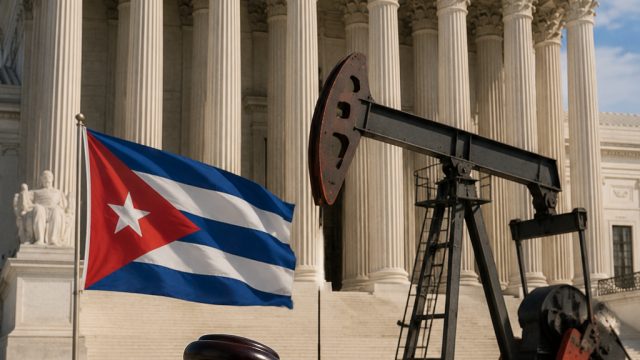
The recent Supreme Court decision favoring ExxonMobil marks a significant turning point in a decades-old dispute over assets confiscated by the Cuban government. This ruling not only impacts Exxon but has broader implications for international business and diplomatic relations as tensions between the United States and Cuba continue to evolve.
In the aftermath of the Cuban Revolution in 1959, Fidel Castro's government seized numerous foreign-owned businesses, including a substantial portion of American investments in the oil sector. Among those affected was Exxon, whose assets were nationalized in 1960. For years, Exxon has sought compensation, with the U.S. government backing its claims under the Helms-Burton Act, which allows American companies to seek restitution for properties seized by foreign governments.
The case garnered renewed attention during the Trump administration, which took a hardline stance against Cuba. The government argued that U.S. companies are entitled to compensation for lost assets, pressing the legal battle forward. This administration’s support was crucial in pushing the case through the courts, underlining the strategic importance of energy investments and international trade relations.
The Supreme Court's decision to side with Exxon is expected to have several far-reaching consequences, not only for the energy sector but also for U.S.-Cuba relations. Here are key points to consider:
In light of the Supreme Court's ruling, Exxon is positioned to pursue its compensation claims more aggressively. This newfound momentum could lead to negotiations between Exxon and the Cuban government. However, the Cuban government has historically been resistant to compensating foreign companies, raising questions about how this will unfold.
Responses to the ruling have varied. Supporters of the decision argue that it provides a necessary framework for protecting U.S. investments overseas, while critics warn that it may lead to isolationist policies that could hinder diplomatic progress. Investors are closely watching how this legal victory will influence future dealings with the Cuban government.
The Supreme Court's ruling in favor of ExxonMobil stands as a pivotal moment in the historical narrative of U.S.-Cuba relations. As the legal ramifications unfold, energy companies and investors will be watching closely to gauge the potential for renewed investments in the Cuban market. The implications extend beyond Exxon, potentially reshaping how American businesses approach foreign investment in politically sensitive regions.
This case is a reminder that, even after decades, the shadows of past conflicts can still shape the economic landscape. For those invested in the future of energy and international business, this ruling may serve as both a challenge and an opportunity.

Revolutionizing Global Trade:
Discover how technology is rev...(84 ) viewsTime:2026-07-10
Wholesale Trade in a Post-Pand
Gain insights into the trends ...(10 ) viewsTime:2026-07-10
Spain and Belgium Clash in Wor
Get insights on the Spain vs B...(65 ) viewsTime:2026-07-10
Leveraging E-commerce for Expo
Explore how e-commerce can dri...(141 ) viewsTime:2026-07-10